Famished AI
activeAgent-commerce infrastructure for AI-to-restaurant transactions — POS, payments, and delivery exposed through an agent-readable protocol, with zero commission to the restaurant.
Overview
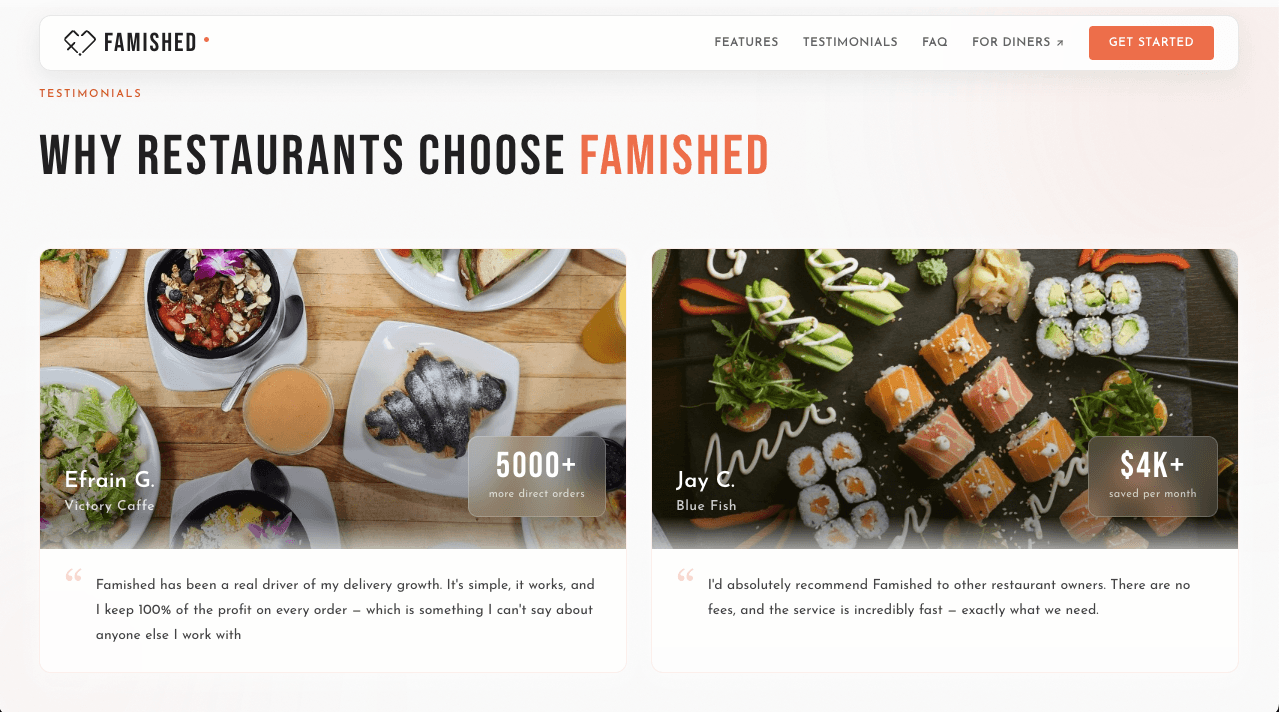
Famished is the agent-commerce infrastructure layer for AI-to-restaurant transactions — a full ordering stack (POS, payments, last-mile delivery) exposed through an agent-readable protocol so autonomous assistants can discover, evaluate, and transact with restaurants without a human in the loop. The model is zero-commission: restaurants keep 100% of order revenue; monetization sits on the consumer side ($2 flat + 10%). Each restaurant is provisioned with a structured, machine-consumable storefront, and the next milestone is native MCP server support so agents can place orders programmatically over a standardized surface. Live in LA with 15 restaurants, $36.8K GMV growing 29% MoM, and a contracted $1.4M ARR enterprise deal with Bevz (600 stores).
Problem
Aggregators take 20–30% of every restaurant order, and AI agents have no standardized way to discover, evaluate, or transact with restaurant backends. As autonomous assistants move from chat to action, the missing piece is a protocol layer — every restaurant either gets repackaged by an aggregator or stays invisible to agents.
Why it matters
Three compounding moats: protocol (authoring the open standard for AI-to-restaurant commerce), trust (zero-commission lock-in at the merchant level), and data (a unified substrate carrying user preferences, restaurant performance signals, and agent-side learnings across every surface). The earliest in-production bet on agentic food commerce — a category that doesn't have an incumbent yet.
Architecture
A modular service backend over a shared data layer, with a vendor-agnostic inventory abstraction so any POS plugs in through the same interface. Discovery runs through a hybrid retrieval pipeline that fuses structured filters with semantic search behind a single LLM hop. Every restaurant is exposed as a structured, agent-readable surface over the same ordering and payments pipeline — with a native MCP server as the next step.
Stack
Python 3 / Flask 2.1FastAPISQLAlchemy + GeoAlchemy2Celery 5.4Postgres 16Redis 7QdrantOpenAI embeddingsGroq (Llama 3.3 70B)TypeScript / React 19Next.js 15React Native (Expo 52)Solito 5NativeWind 4.1Auth0StripeMapbox GLSentryKubernetes
What I learned
Leading a small team at startup speed taught me that velocity and craft aren't in tension — they compound when the team trusts each other enough to ship hard and rest harder. I keep the bets narrow, the feedback honest, and protect the team from chasing the wrong metric. Moving fast is the easy part; knowing when to slow down for the people doing the work is the actual job.